

Architectural Gilding
Architectural gilding is gold leaf laid by hand on a building’s own surfaces: cornices, ceiling roses, mouldings, capitals and lettering. We gild in 23.5 carat gold in London, across the south of England and on selected projects around the UK, for livery halls, royal palaces, clubs, synagogues, schools and private houses, including Fishmongers’ Hall, Apothecaries’ Hall, Kensington Palace and West London Synagogue.
Gilded ornament has been used in English interiors since the seventeenth century to pick out cornices, roses and enrichments, and much of it has since been dulled or painted over. In the Coffee Room at the Travellers Club, Charles Barry’s Grade I clubhouse on Pall Mall, the roses, guilloche, bead and reel and cornice brackets were newly gilded in 23.5 carat loose leaf, and the existing gold on the egg-and-dart was cleaned and kept.
Led by Chris Britain, Master Decorator, and Cathy Britain ACR, Icon-accredited Conservator-Restorer, with an experienced team. Chris has worked in the trade since 1974, the third generation of his family; he and Cathy founded Britain & Co in 2015.
Gold and light

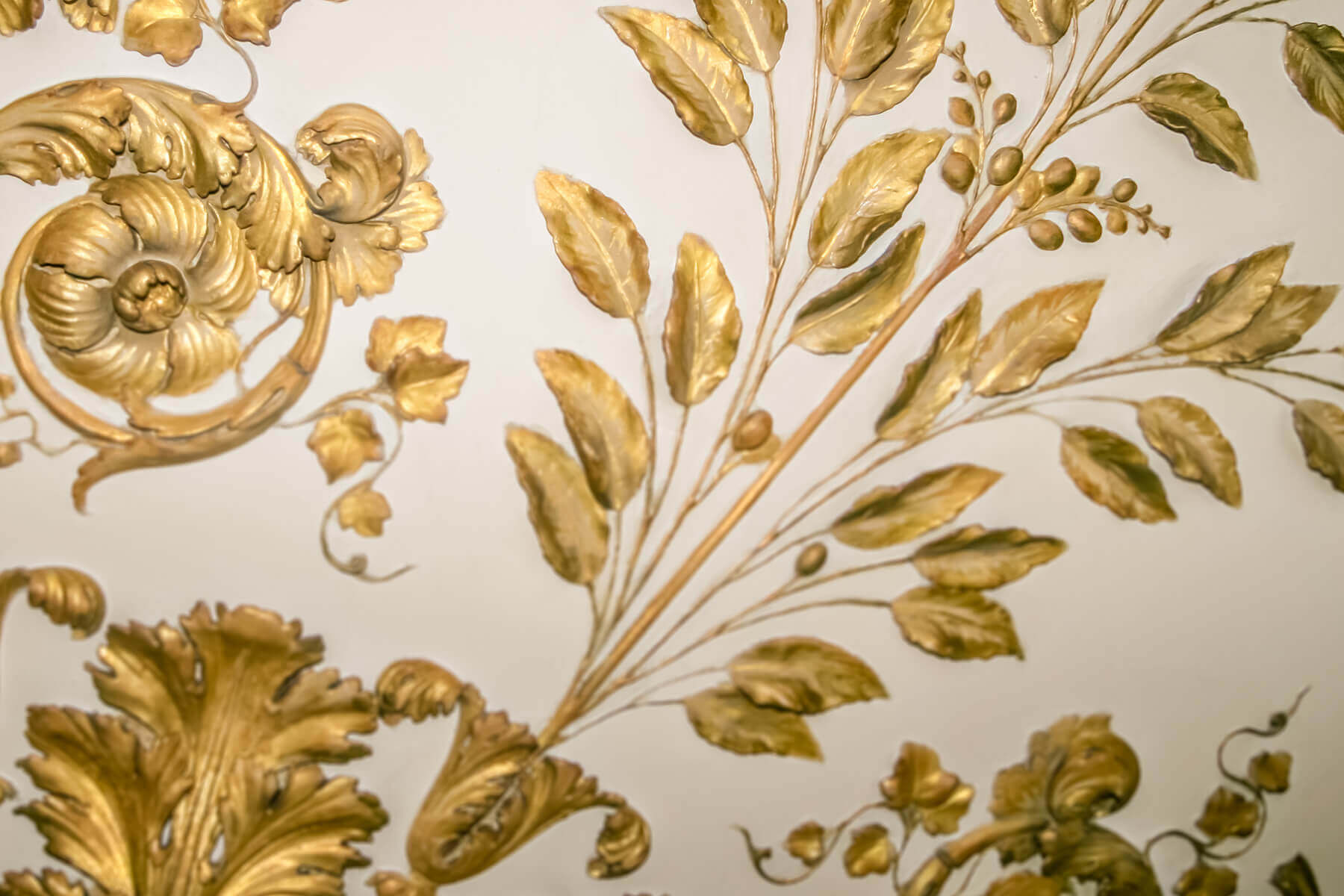
Gold leaf is thin enough to take the exact shape of whatever lies beneath it. On an egg-and-dart or a ring of acanthus it catches the light on the high points and leaves the hollows in shadow, so the ornament stands out from the plaster.
Visitors to Fishmongers’ Hall all come in through the entrance hall and along the corridor, so the gold there is seen at arm’s length. Rubbing the enriched plasterwork down by hand took weeks; then more than a thousand books of double-thickness leaf went onto the cornices, enrichments, ceiling roses and door mouldings.
Laying the leaf

At Kensington Palace our gilders oil gilded the doors, shutters, dado and skirting mouldings, roses and cornices of the Queen Victoria Rooms for Historic Royal Palaces.
In the unheated chapel at West Norwood the size was still soft the next morning, so the team tested for several days and changed it before laying gold over the stencilled coffers and their sun-ray bosses.
Old gold and new

Much of our gilding is in rooms that already have gold in them. Leaf straight from the book is brighter than gold that has hung in a room for a century, so we sample in the room, old beside new, before the main work begins. At Apothecaries’ Hall the Parlour cornice and ceiling rose were regilded in 23.5 carat leaf once the client had seen both side by side.
Sometimes very little new gold is needed. In the Speech Room at Harrow School the armorial panels above the stage were assessed one by one, cleaned, selectively regilded and glazed to match one another. On a gilded ceiling in a Grade I listed London house, the old gold was cleaned after trials and new leaf went on only where cleaning failed: fewer than six sheets in the whole room.
Working in buildings in use

Many of the rooms we gild stay in use while we work, from a club open to its members every day to a palace on the visitor route. Leaf lifts in a slight draught and fresh size picks up dust, so we agree with the client when we can have the room to ourselves. At Fishmongers’ Hall, Saturday shifts were kept for the gilders.
Gold lettering is set out in full before any size goes on. At West London Synagogue the Hebrew inscription on the gilded band at the base of the central dome was set out from full-size templates and proof-read by the Rabbi. At Palace Green every stencil of the poem that runs round the dining room was placed dry on the wall first, then gilded in 23.5 carat leaf.
In detail


Selected work

Fishmongers’ Hall, London Bridge
The entrance hall and corridor in 2024: more than a thousand books of double-thickness leaf, with stencilling and coach lining, for the Fishmongers’ Company and Sykes & Son.

The Travellers Club, Pall Mall
The Coffee Room in Charles Barry’s clubhouse: new gilding in 23.5 carat loose leaf across the ceilings and cornice, with the surviving original gold cleaned and kept beside it, in colours researched by Patrick Baty.

The Speech Room, Harrow School
William Burges’s Grade II* hall, with the armorial panels cleaned, selectively regilded and glazed to match one another. Photograph: Paul Highnam.

Kensington Palace
Oil gilding in 23.5 carat loose leaf through the Queen Victoria Rooms for Historic Royal Palaces, in 2019 and 2020.

St Stephen’s Chapel, West Norwood
Gold laid last over our stencilled coffered ceiling, on the sun-ray bosses and the ornament around them.

West London Synagogue, Marylebone
23.5 carat gold on the pendentives, the inscription band at the base of the central dome and the lattice of the organ dome, within the restored polychrome scheme of the Sanctuary.

A private house on Regent’s Park
A new ballroom: the dome lattice, acanthus ring, coffers, capitals and cornices parcel gilded in 22.5 carat champagne gold, polished to a soft sheen.

Manchester Jewish Museum
The Grade II* synagogue of 1874, its late Victorian scheme recreated from our paint research, stencilled and gilded, for the museum’s reopening in 2021.
Also
FCDO, King Charles Street. Gilt that had been painted over was regilded in the Fine Room Corridor (2017 to 2018), and damaged gilding on the Grand Staircase landing and the Foreign Secretary’s Corridor was repaired in 23.5 carat leaf and aged to match (2024).
The Locarno Suite, Foreign Office. Selective repair and reinstatement of two areas of the stencilled and gilded scheme after a water leak, with colour matching and hand-cut stencils.
In the press
- One Palace Green: returning style and splendour to a monument of the Arts-and-Crafts Movement, Country Life, 2026
- Kensington Palace behind closed doors, Historic Royal Palaces, 2019
Common questions
Can you match existing gilding? Yes. We sample in the room, new leaf beside the old gold, and agree the carat, finish and any toning before the main work starts.
Real gold or imitation leaf? For architectural work on a significant building we usually recommend genuine gold. Imitation leaf such as Dutch metal costs less, but it can tear on fine detail and needs varnishing so leaf and ground read as one; we settle the choice at estimate.
Oil gilding or water gilding? Almost all gilding on a building is oil gilding, which follows a moulding closely and gives a soft sheen. Water gilding, burnished over gesso and bole to a mirror finish, suits small elements close to the eye.
How is gilding priced? We price the gold and the labour separately and openly at estimate, together with the preparation and access the work needs. Coverage is often a choice, a cornice gilded solid or only on its highlights, and we can price both.
How long does gilding last? Indoors, oil gilding in genuine gold lasts for generations if it is kept clean and dry. Outside it depends on exposure; see Exterior Gilding.
Do you gild in place? Yes. We gild cornices, ceilings, joinery and built-in frames where they are. Loose frames and furniture go to a specialist workshop, and we can suggest one.
Do we need consent in a listed building? Regilding or adding gilding in a listed interior may need listed building consent. We work with your architect and conservation officer and can provide samples to support an application.
If you have a ceiling, a cornice or a whole scheme that needs gold, tell us about your project.
See also: the Gilding hub · Exterior Gilding · Gilding Restoration